Area Meeting Dates


The Burt County Board of Supervisors will meet Thursday, February 27th at 9:00 a.m. at the Burt County Courthouse.

The Lyons City Council will meet Tuesday, March 4th at 5:30 p.m. at the Lyons City Office.

The Oakland City Council will meet Monday, March 10th at 7:00 p.m. at the Oakland City Auditorium.

The Oakland-Craig Board of Education will meet Monday, March 10th at 8:00 p.m. at the Oakland-Craig High School.

All meetings are open to the public.

Bancroft Senior Center News


Bancroft Senior Center News

* The senior center provides Information and Assistance to any individual who is looking for services for themselves or another person 60 years and older, the center manager and/or center participant can provide information to individuals on services available within the community. We link individuals to the services and opportunities that are available within or beyond the community itself. We will then establish adequate follow-up procedures to see that their needs were met. For more information call 402-648-3387.

*If you are 60 years and older and need information on programs designed to help keep you in your home longer or if you need legal help, contact Connie at 402-648-3387 or in the evening at 402-648-7648.

* We have the following medical equipment to loan out on an as need basis, wheel chair, bath seats, toilet seat riser and portable toilet chair, crutches or walker. Call 402-648-3387 during office hours.


Meals on Wheels

The Meals on Wheels program started in Bancroft February 10th. Anyone over the age of 60 years and lives within the city limits are eligible for these meals. You may sign up anytime for the Meals on Wheels program; you can get the meals delivered however many times you want them each week. You must call 402-687-2332 before 8:45 if you want a meal that day.

We need more volunteers willing to deliver the meals once they get to the senior center in Bancroft. Contact the senior contact 402-648-3387 if you wish to help deliver the meals, want a meal delivered or have a question.


Weekly Activities:

Wed. Feb. 26: No melody chimer practice today. Join us for coffee anytime during the day. Play bowling on the Wii game at 1:00 and play bingo at 2:00

Thurs.: Feb. 27 Pool 9:30. Tai Chi class at 9:30 and the walking ex. class at 10:30. Stop in for coffee at 10:00. Remember to sign up to play in the pitch tournament at 1:30 today.

Fri. Feb 28: Have you signed up for the meatball dinner at 12:00? There will be a pinochle tournament and hand and foot card game at 1:30.

Sat. March 1:  Come to the music jam at 7:00 to enjoy the entertainers perform; bring some finger foods for lunch.

Mon. March 3: Bring a covered dish and enjoy the potluck noon meal with your friends. After the dishes are done we will play cards. Work on the jigsaw puzzle.

Tues. March 4: Play pool at 9:30. Tai Chi class at 9:30 and the walking ex. class at 10:00.  Sign up for the pitch tournament at 1:30. Work on the jigsaw puzzle

Wed. March 5: No melody chimer practice today.  Stop in and have a cup of coffee. Come and play the card game 65 or dominoes at 1:30.  Work on the jigsaw puzzle anytime you are at the center.


National Tortilla Chip Day


Today is National Tortilla Chip Day. Every day is designated something.Did you know that the corn chip recipe was brought to the U.S. from Mexico by texas businessman Elmer Doolin? So, get out your corn chips and salsa and enjoy your day!

Keep Looking Up


“The Quest for Other Solar Systems”
In the 21st century we have seen evidence for the existence of other solar systems in our Milky Way Galaxy.  What are the techniques astronomers have used to find planets around other stars?  What stars in our sky harbor these planets?  Are any of these new found planets around other stars like our Earth?
Come to Northeast Nebraska Astronomy Club (NENAC) this Friday, February 28 at 7pm at the Lyons Library and Saturday, March 1 at 7pm at the Decatur Sears Center and find out about “exoplanets”, planets around other stars in our galaxy.  Pastor Gary Fugman will lead a discussion about how motions of the stars leads us to discover other solar systems.  How you with your computer or smartphone can help in the discovery of planets in other solar systems will be discussed.  What an exciting time we live in, a time of reaching out and really discovering “New Worlds”!
Then at 8pm, weather permitting, Friday we will go to Cory and Tracie Martins’ south of Lyons and Saturday to Fugman Observatory on the south side of Decatur to observe the night sky through large astronomical telescopes.  The planet Jupiter and other deep sky objects will be observed. You are invited to bring your binoculars or telescope as well.  Please dress warmly as temperatures drop quickly after sunset.
For more information on this and future NENAC presentations, please call Pastor Gary Fugman at 349-1953, and Keep Looking Up!

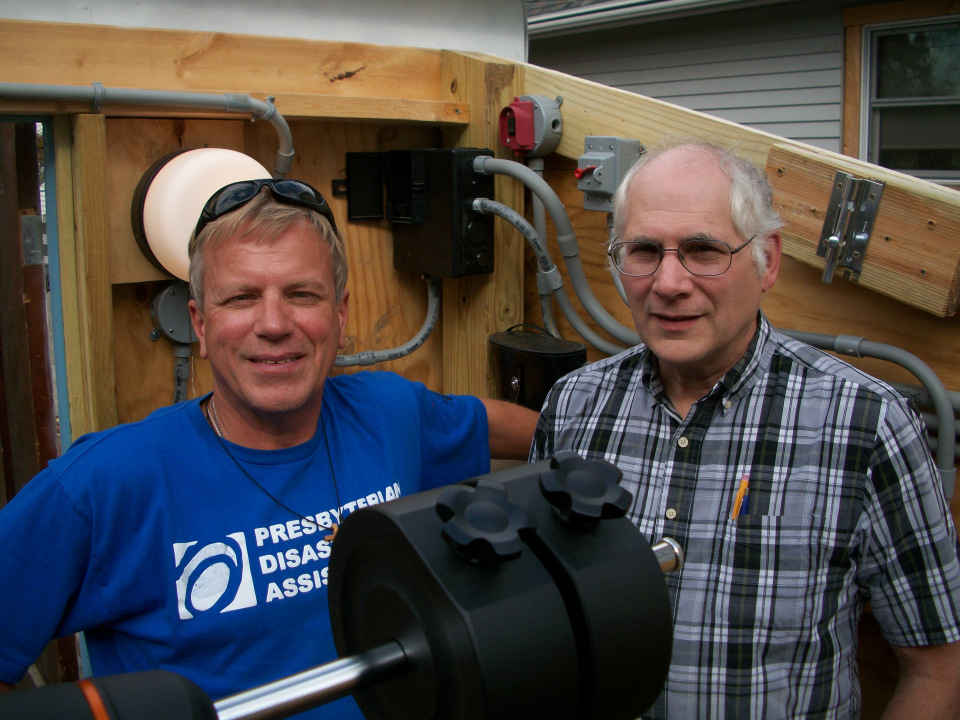
Gary and Bill at the Hedges Lost in Space Observatory. Photo courtesy of NENACSTARS.

Gary and Bill at the Hedges Lost in Space Observatory. Photo courtesy of NENACSTARS.

Cornhusker Economics Outlook


John Wilson

John Wilson


Cornhusker Economics Outlook – Don’t Miss It!

The ninth annual Cornhusker Economics Outlook meetings will focus on the current ag outlook and management decisions for farmers. The meetings will be held at nine locations across the state, but the closest session will be in West Point on Thursday, March 6, from 9:00 to  11:30 a.m. at the Nielsen Community Center.

The meetings are a concise, fast-paced discussion of crop, livestock, policy and land outlooks for 2014. They are sponsored by University of Nebraska-Lincoln Extension and the UNL Department of Agricultural Economics with support from the Nebraska Corn Board, the Great Western Bank, and local sponsors. Topics and presenters at this years meetings include:

Kate Brooks, UNL extension livestock economist, will provide a current status of the industry and analysis for beef and other livestock producers. Brooks, whose expertise is in market analysis and production economics, recently led a study of livestock industry trends in Nebraska. She will interpret emerging livestock market fundamentals, meat supplies, and meat demand to assess producer profit potential and sound marketing and production decisions in 2014.

Cory Walters, a new UNL extension crop economist, will address crop marketing and risk management, using his substantial research on crop marketing and crop insurance strategies and decisions. Walters brings experience from both Kentucky and a farm background in Montana to his new role in Nebraska. He will discuss the outlook for corn, soybeans, and wheat to help producers make sound production, marketing, and risk management decisions.

Brad Lubben, UNL extension policy specialist at UNL, will provide perspectives on the policy environment in Washington and the long-awaited farm bill. With Congressional efforts in January and early February, producers will finally be able to focus on farm program decisions rather than continuing deliberations. Lubben will discuss the policy outlook and program alternatives to help producers effectively combine farm programs, crop insurance, and marketing strategies for success.

And finally, Al Vyhnalek, extension educator in Platte County, will provide additional information on current land and leasing economics. With declining crop prices and profitability projections for 2014 and land and rental prices still high, producers will need to push an even sharper pencil on land and leasing decisions and production plans.

For more information on the Cornhusker Economics Outlook meetings, contact your local UNL Extension office.


Emerald Ash Borer Update

Emerald ash borer has been in the news for several years and likely is the next insect that will lead to large numbers of landscape trees dying. This borer has been in the news long enough- people are asking if they should treat their ash trees. The recommendation of UNL Extension and the Nebraska Forest Service is to wait until emerald ash borer has been found 15 miles from a location before treating an ash tree.

Emerald ash borer has not yet been found in Nebraska. It has been confirmed in Iowa, 80 miles east of Plattsmouth NE, and in Boulder, Colorado. While it may be tempting for homeowners to treat valuable ash trees, there is little benefit to treating too early. After a tree has emerald ash borer, treatment can still work.

If you have an ash tree you know you will treat when needed, now is the time to become familiar with treatment options. The Nebraska Forest Service has a good guide for homeowners. Go to the forest service website (http://nfs.unl.edu/eab) or call your local UNL Extension office.
Great Backyard Bird Count Coming


By John Wilson

John Wilson

John Wilson

This open winter hasn’t been great for bird watching, they don’t seem to come to our feeders when the weather is nice. But my wife and I notice an increase in activity on particularly cold or windy days. We enjoy being able to sit at the dining room table and see all the different birds that come in to feed.

Based on our experiences, here are a few suggestions if you are feeding our feathered friends. Anyone who feeds birds knows how easy it is for seed to turn moldy in feeders. Moisture from snow or rain can leak into feeders and turn bird seed into potential sources of illness for birds. You should keep feeders clean to help prevent the spread of disease to backyard birds.

Clean and disinfect feeders on a regular basis, taking care to scrape out old moldy seed that collects in corners. Wash feeders in warm water with dish soap and rinse. Disinfect with a solution of one part liquid chlorine bleach to nine parts warm water. Make sure feeders are completely dry before refilling with seeds.

It’s important to keep feeding birds once you start so they don’t become dependent on you as a food source, only to run out of food during periods of severe weather. You know, the kind of days you really don’t want to go outside to fill the bird feeders.

Also, if possible, provide water for birds. This is extremely important during the winter because other sources of water may not be available. It seems chilly, but birds regularly use our heated bird bath. Besides water to drink, they use it to help keep their feathers clean which makes them, for lack of a better term, fluffier! This extra insulation gives them better protection against bitter cold temperatures.

Now, if you REALLY enjoys bird watching, there’s an event in February you won’t want to miss … and you can take part from the comfort of their home. The 17th annual Great Backyard Bird Count will be February 14–17. Participants are needed to count birds in their yards, neighborhoods, or other locations. Simply tally birds for at least 15 minutes on any day of the count, then go to www.birdcount.organd enter the highest number of each species seen at any one time.

This program used to be held in the United States and Canada, but is now conducted worldwide. Coordinated by the Cornell Lab of Ornithology, Audubon, and Bird Studies Canada, the count provides an instant snapshot of birdlife across the continent. Organizers hope to receive more than 100,000 checklists during the event. Also, you can watch as the tallies come in at www.birdcount.org.

Whether you observe birds in your backyard, a parks, or a wilderness area, the Great Backyard Bird Count is an opportunity to share their results at www.birdcount.org. It’s fun and rewarding for people of all ages and skill levels–and it gets people outside… or you can watch from inside, too!

Information from the Great Backyard Bird Count participants is even more valuable as scientists  try to learn how birds are affected by environmental changes. The information you send in can provide the first sign that individual species may be increasing or declining from year to year. It also shows how a species’ range expands or shrinks over time. A big change, noted consistently over a period of years, is an indication that something is happening in the environment that is affecting the birds and that should be followed up on.

So, to take part in this activity for the birds, go to www.birdcount.org for online instructions and tally sheets… then enjoy our feathered friends. My wife and I participated for the first time last year… it’s easy and it’s fun!

Paper Piecing Class


Cactus Flower Tablerunner

Judy Niemeyer Paper Piecing Class

February 22nd, and 23rd, 2014

Community Center, 413 Main St

Blencoe, IA  51523


Sponsored by Susie’s Quilt Shop

1112 2nd St., Onawa, IA 51040

(712) 423-9625

Come and join us for a fun weekend of learning Judy Niemeyer’s paper piecing techniques.  We will be going over how to use Judy’s cutting instructions to help you cut out paper templates and foundation papers to create a beautiful paper pieced tablerunner.  Judy’s techniques enable you to piece very difficult looking patterns and quilts with ease.  Please contact Susie’s Quilt Shop for fabric, patterns, and detailed information about the class.

For any other questions please contact:

Connie Lange – (402)371-8281

cjlange@cableone.netSpecial Garden Project 2014

Protect Young Trees


By John Wilson

Extension Educator

Recently I’ve talked about injury we might see on evergreens or turf with our open, dry winter. Today I wanted to visit about another kind of injury that often occurs on trees during the winter, but it doesn’t matter on this one whether we have lots or little snow.

While evergreen trees and shrubs are susceptible to winter desiccation or drying, sunscald is a winter injury that can occur on southwest side of deciduous or broadleaf trees. Sunscald occurs when tree bark warms up on sunny days and dormant cells become active. Once active, plant cells lose some of their cold hardiness and are then injured when temperatures drop at night.

Sunscald damage appears as discolored bark, cracking, or sunken areas. This damage stresses trees and provides an avenue for insects and diseases to enter. Often the injury may take place under the bark, but it doesn’t become evident for a year or more.

Sunscald is mainly a threat to young, thin-barked trees with southwest exposure. As most young trees mature, they develop thicker bark and become less susceptible to sunscald injury. However, trees that have thin, dark-colored bark, such as cherries, peaches, and plums, even as they mature can remain susceptible even with age.

Drought stressed trees are more susceptible to sunscald than trees that go into winter well-hydrated. This is another reason to pay attention to correct fall watering; especially of young trees. Deep watering and using mulch to conserve soil moisture are good practices.

Avoid over pruning young trees, especially removing lower limbs earlier than needed. Lower limbs provide some shade to tree trunks during winter. Wait two to three years after planting before removing the lowest tree limbs. If possible, plant susceptible trees to the north and east of buildings or of evergreens. This way, the lower portions of the trees will be shaded during winter.

Protecting trees from sunscald is fairly easy and inexpensive. Wrapping the lower branches and trunk of susceptible trees with light colored tree wrap during winter is the best prevention. Tree wraps can be purchased at most home and garden stores.

White or light colored tree wrap reflects light helping to keep tree bark cooler. Dormant cells then remain inactive and are at less risk of being injured by temperatures dropping at night or suddenly when a cold front or cloud cover comes through.

Ideally, wraps should be put in place in late fall. If you have a susceptible tree, there is still time to protect it. As air temperatures warm in mid- to late winter, the risk of sunscald increases. Warm winter days followed by cold nights can be more common in late winter.

All tree wraps need to be removed in spring after the risk of freezing has passed. Tree wrap left on a tree during the growing season can harbor pests and hold moisture against a tree trunk which may promote disease.

Sometimes people with orchards paint the trunks of fruit trees white during winter. This is usually not acceptable in a landscape, but if trunk painting is done use an interior latex paint. Some exterior paints contain antimicrobial agents that could damage a tree.

If sunscald injury does occur, the area may repair itself. In the meantime, damaged areas should not be painted with a wound dressing or filled with any sealing substance such as paint or tar. These products can interfere with the trees own natural process to close the wound.

For more information on protecting trees from sunscald, contact your local UNL Extension office.

Senator Lydia Brasch


Senator Lydia Brasch

Senator Lydia Brasch

Looking back on last week, Legislative days 18 through 22, multiple ongoing discussions continue to grow regarding legislation pending and in progress. The conversations happen not only at the State Capitol, but also with constituents and others across the state. Of my bills introduced this session the first one to be heard in committee was LB964. The Judiciary Committee hearing on Friday, the 7th was brief but effective. There were two bankruptcy attorneys who spoke in support of LB964. No one spoke in opposition or in a neutral capacity. This bill allows the bankruptcy homestead exemption to be extended to everyone, including single individuals under 65 years old. Current law applies only to single individuals 65 and older and heads of a family (single persons with dependents living in the same home). This bill allows all single people who file for bankruptcy to claim up to $60,000 of the equity they have on their home as an exemption. The committee members had only a few questions about the bill, including one from Chairperson Brad Ashford about why the law had not been amended a long time ago to include single individuals under 65. Please note LB964 has no effect on taxation and should not be confused with the similarly named homestead tax exemption.

Another of my bills from this session, LB1082, which allows all-terrain vehicles (ATVs) and utility-type vehicles (UTVs) to be used as authorized emergency vehicles, was heard in the Transportation and Telecommunications Committee hearing on Monday, the 10th. Presently, ATVs and UTVs are restricted from crossing highways with more than two lanes unless they are used for electric utility purposes, but must be properly licensed and insured, must only be operated under 30 miles per hour, and must have the proper lighting and safety equipment, including a bright orange bicycle safety flag. LB1082 allows fire and police departments and volunteer rescue teams to outfit ATVs and UTVs for emergency response use on and around large highways during day and evening hours. This will be especially valuable to rural communities when their standard emergency vehicles cannot easily reach areas far off the beaten path.

Tuesday, February 4 marked the third day of debate on LB399, allowing amber lights on any public safety volunteer vehicle. After eight hours of debate and a bracket motion that failed 16-24, a vote for cloture (an action to cease debate on a bill and immediately vote for its advancement) failed by one vote (32-12). After a failed cloture vote, debate on that particular bill is prevented for the rest of the day. LB399 remains in Select File.

The Revenue Committee heard it’s first two 2014 ag property tax reduction bills this year with LBs 670 and 813. Currently at 75 percent of the land’s actual value, LB670 would gradually phase-in a 65 percent valuation by tax year 2017. The bill was heard by the Revenue Committee on Friday, the 7th, and committee action is pending. LB813 would drop the valuation from 75 to 65 percent immediately after 2015. Last year I introduced LB145, a bill I was asked to carry in 2013 on the behalf of the Farm Bureau, which offers an immediate 10 percent reduction similar to those that former State Senators Fischer and Heidemann introduced during their terms. LB145 is still being held in the Revenue Committee.

Please contact me, my administrative aide, Katie Wattermann, or my leglisative aide, Joe Neuhaus, with questions or thoughts at (402) 471-2728 or by email at lbrasch@leg.ne.gov.
If you are in Lincoln, please stop by Room 1016. We would love to welcome you. Otherwise, please catch the NETV coverage on your local station or at

http://www.netnebraska.org/basic­page/television/live­demand­state­government.

page1image30720

Keeping the Good Life growing in Nebraska, Senator Lydia Brasch, District 16

Colon Cancer Screening Kits Available


For Immediate Release

February 11, 2014

Contact: Matt Punelli – matt@elvphd.org

Elkhorn Logan Valley Public Health Department


Free Colon Cancer Screening Kits Available

Colon cancer is preventable and treatable if discovered early, so now is the time to think about getting screened. Over 90% of colorectal cancer cases are found in adults aged 50 and over, which is why yearly screenings are important if you are over 50. Treatment is most effective when colon cancer is detected early, and screening can even prevent colon cancer by finding and removing polyps before they become cancer. The Elkhorn Logan Valley Colon Cancer Prevention Coalition has free Fecal Occult Blood Test (FOBT) kits available at area locations.


Kit locations in Cuming County:

  • Shopko Pharmacy in West Point
  • Tom’s Rexall in West Point
  • Dinklage Medical Clinic in West Point
  • Cuming County Extension Office
  • Wisner Pharmacy
  • Wisner Family Practice
  • Elkhorn Logan Valley Public Health Department


Kit locations in Burt County:

  • Tekamah Mercy Medical Clinic
  • Wragge Pharmacy in Tekamah
  • Lyons Public Library
  • Oakland Public Library


For more information about the free FOBT kits please contact the Elkhorn Logan Valley Public Health Department at (402) 529-2233.


###