Ground Ivy Control


By John Wilson, Extension Educator

I expect to get certain kinds of calls at certain times of the year. My observations as I drove around led me to believe, and my suspicions were confirmed by the large number of calls I’ve received… 2016 is an excellent year for ground ivy in lawns. There is a small fortune, probably a large fortune, to be made if someone could just find a good use for this weed. One of my Extension co-workers says it best, “Ground ivy is a very horrible weed.”

Ground ivy is a perennial broadleaf weed, meaning that it comes back from the roots year after year. This plant is the one that grows low to the ground and sends out runners, has scalloped leaves like a seashell, and has a small purple flower. It also has square stems and smells like mint when you mow over it because it is a member of the mint family.

People want to control it now, but this is very difficult. The major flow of energy and nutrients in the plant in spring is from the roots, where it was stored overwinter, to the above ground portion of the plant. Broadleaf herbicides applied now may burn the top growth and slow it from spreading, but it rarely gives satisfactory control at this time of year.

The optimum time to apply selective herbicides (kills broadleaf plants, but not the grass) is in mid-September to mid-October when there is adequate moisture and warm temperatures, good growing conditions, so the herbicide will be translocated to the roots. The good thing about treating then is, that is also the best time to control other perennial broadleaf weeds like white clover and dandelions.

The other herbicide alternative at any time of year are nonselective products containing glyphosate (Roundup) which will kill everything, weeds and grass, and then you would need to sod or reseed. So it is best to only use this in the spring or fall when you would normally establish new turf. This is a last resort measure when there is not enough grass to try to salvage using a selective broadleaf weed killer.

Even when you apply a selective herbicide in the fall, you will not achieve 100% control with a single application. You will have better luck with two applications about three weeks apart in the fall with the second application spot treating plants you did not control with the first application. Remember, to be effective, the plants need to be actively growing to metabolize the herbicide.

There is another alternative for use on bluegrass lawns ONLY! (Injury may occur on turf type fescues, buffalograss or any other species of turf.) This is based on some research that was conducted at Iowa State University.

Researchers there discovered ground ivy could be controlled with an application of borax. This nutrient can also be toxic to plants above certain levels. Ground ivy cannot tolerate as high a level of borax in the soil as can bluegrass. This difference in tolerance allows us to selectively control ground ivy while leaving bluegrass. Treatment can be made in spring or fall.

A borax-containing detergent (Borateem, 20-Mule Team Borax, etc.) Was dissolved in hot water, allowed to cool, and applied to infested lawns. Three concentrations of borax solution were used in the experiment. In the Iowa State study, each treatment was applied at a rate of 2.5 gallons of water plus the amount of detergent indicated per 1,000 square feet of lawn. Dry detergent was also applied at the highest rate for comparison. Control rates are shown below:


Treatment Control
  5 ounces 84%
10 ounces 81%
20 ounces 93%
20 ounces (dry) 74%

When treating your lawn, it is important to calibrate your application equipment. The rates are given as so many ounces per 1,000 square feet (an area about 31.5 feet square). You need to measure an area this size and spray it using plain water in your sprayer to determine how much water you apply per 1,000 square feet. Then dissolve the desired amount of detergent in that much water for each 1,000 square feet of lawn you need to treat.

For example, I fill my sprayer with water and spray a 1,000 square foot area. It takes one gallon of water to refill my sprayer so now I know I apply 1 gallon per 1,000 square feet. Then I measure the area I wanted to treat. It is an area 75 feet long and 40 feet wide or 3,000 square feet (75 x 40 = 3,000).

Since I determined I apply one gallon of water per 1,000 square feet and I want to treat 3,000 square feet, I heat three gallons of water and dissolve 60 ounces (3 x 20) of detergent in three gallons of water. I then let the spray solution cool and put it in my sprayer. If I walk at the same speed, this should just cover the 3,000 square feet.

Best results are achieved using a small pump sprayer. This is the easiest way to get a uniform application. People I visited with last year also reported using a sprinkling can or just shaking dry detergent from the box onto the lawn and then watering the lawn to soak it into the soil. Some had good luck with these methods while others indicated skips or areas where they burned the turf because of under- or over-applications.

It is important to note only slight damage to grass occurred when these experiments were conducted on bluegrass lawns. However, the same treatments caused more severe burn to tall fescue lawns. Also, rates higher than 20 ounces per 1,000 square feet were only slightly more effective on ground ivy but caused serious damage to bluegrass.

For more information on ground ivy other lawn weed control, contact your local Nebraska Extension office.


Brown Spots in Lawns


By John Wilson, Extension Educator

The warm humid conditions we’re experiencing can promote diseases such as dollar spot and brown patch. If brown patches appear in your lawn, diagnose the problem before applying a pesticide. Disease and insect pests can build up resistance to pesticides, especially if they are overused. Pesticides are also chemicals we should not put into the environment unless they are needed.

            A pesticide should only be applied after a problem is diagnosed; it is determined control is needed to reduce unacceptable damage; and it is the right time of the season to apply a pesticide for effective control. 

            Brown patches in lawns are caused by a number of things ranging from diseases and insects to heat or drought stress to dog urine or gas spills. To help with diagnosis, look closely at green grass blades near the brown patches. Do this before mowing your lawn, not immediately after.

            If green blades appear bleached white at the tip, this most likely is Aschochyta tip blight and lawns easily recover without a fungicide. Tip blight most often develops when hot weather follows rainy periods… kind of like the weather pattern we’re entering now. After a week or two, the lawn usually grows out of the damage.

            If there are tan bands with red margins all the way across the green grass blades, this is dollar spot disease. It’s often brought on by low nitrogen so we recommend fertilizing instead of applying a fungicide for control. However, we would not recommend fertilizing during July and August, but you would want to be sure to make a fertilizer application in early September.

            If green grass blades have irregular tan spots with red margins, and these lesions do not encircle the blade, this is brown patch disease. Fungicide applications are recommended and can be effective in stopping the spread of brown patch if applied as soon as the disease appears.

            If no bleached tips or lesions (spots) can be found on green grass blades near a brownish lawn patch, then the problem might be a root disease, insect damage, environmental, or something else. 

            Two root diseases are summer patch and necrotic ring spot. Both are identical in appearance and form the symptom known as frog-eye. The frog-eye symptom is a brown to tan patch of grass with a tuft of green in its center.

            The two fungi that cause these diseases infect roots in the spring; even though symptoms do not begin to appear until late spring for necrotic ring spot or mid- to late summer for summer patch after the disease weakens the root system.

            Fungicides can help in reducing these two diseases, but are best applied in mid-April and one month later for Necrotic ring spot; and in early to mid-May and one month later for summer patch. For both of these diseases, overseeding with disease resistant cultivars will provide the best control in the long run.

            As for insect problems of lawns, our most common insect pest is white grubs. It’s too early for white grub damage; however, now is the right time to apply insecticides containing imidacloprid to lawns with a history of grub damage. Other grub insecticides should be applied around the first of August.

            Keep in mind repeated applications of insecticides containing the same active ingredient year after year could result in grubs building up a resistance to these chemicals. It is best to apply these products only to lawns that have had a recent history of white grub damage. If you need to treat again next year, use an insecticide with a different active ingredient.

            For more information on lawn disease and insect control, contact your local Nebraska Extension office.
Emerald Ash Borer


By John Wilson, Extension Educator

The emerald ash borer (EAB) is an insect that’s been in the news for over 10 years. It has the potential to be devastating to ash trees when it gets to Nebraska… but the key word here is WHEN! Emerald ash borer has not yet been found in Nebraska. The nearest it has been confirmed is in Iowa, about 80 miles east of Plattsmouth, Nebraska.

This borer has been in the news long enough tree owners are asking if they should start treating, or take the more radical step of removing  ash trees. I just had someone in my office last week that wanted to cut down a couple healthy ash trees because of this potential threat.

Hopefully I talked them out of that. I explained that I have an ash tree just east of my house and I’m sure someday I may need to remove it if ash borer gets here. But I’m not going to cut it down now and give up potentially 10 to 15 years of shade and beauty for a pest that might get here someday. And I’m not going to spend money on treatments to treat a pest that is not here.

The recommendation of the Nebraska Forest Service and Nebraska Extension is to wait to begin treatment until emerald ash borer is confirmed to be within 15 miles of a tree. EAB is not a strong flyer and doesn’t move great distances on its own. According to the Nebraska Forest Service, treating trees beyond 15 miles will likely provide little or no benefit to the tree but will result in unnecessary environmental exposure to pesticides as well as unneeded expenses.

If you have an ash tree, you should know that state and federal agencies are monitoring emerald ash borer infestations and will provide updates when it is found in Nebraska. Information about it and about when and how to treat ash trees can be monitored on the Nebraska Forest Service website. Go to nfs.unl.edu.

After I tell people to wait, I’m often asked what if emerald ash borer is in Nebraska but hasn’t yet been found. It can take up to five years for this borer to kill a tree. So once it is confirmed, it has likely been in the state for at least a couple years. However, unlike pine wilt killing Scotch pine where the tree must be treated prior to the nematode infesting the tree, ash trees that are already infested with emerald ash borer are still treatable and can be saved if the damage is not too severe.

Instead of making pesticide applications likely to be of little benefit, become more informed to help make decisions about EAB. If you have an ash tree, decide if you are willing to treat the tree on an annual basis or if you will replace the tree.

Valuable trees, such as those providing shade for a home and are in good condition, may be worth the cost of an annual treatment. Trees with health or structural issues or those not planted in key locations, may best be replaced rather than treated annually. For example, if a tree has branch dieback, sparse foliage, or severe trunk injuries, it is probably not worth the expense of treating.

If you are planting a new tree this spring, avoid ash trees. Most types of ash are susceptible to emerald ash borer. If you know you will not treat an ash tree once it is infested, do you have space on your property to plant another tree now to take over the landscape function if the ash tree dies?

When Dutch elm disease killed American Elms, many of these trees were replaced with green ash. This created another monoculture susceptible to pests. We could now lose a large percentage of these trees. Let’s not make the same mistake twice. Select trees not common in the landscape for more diversity.

A few readily available large trees to plant are honeylocust, American linden, Norway maple, Miyabe maple, hybrid elms and white oak. Other species not frequently planted in a landscape include Kentucky coffeetree, shagbark and bitternut hickory, silver linden and horse chestnut.

For more information on emerald ash borer or on selecting a replacement shade tree, contact your local Nebraska Extension office.
John Wilson

John Wilson

Open Winter Injury


John Wilson

John Wilson

By John Wilson, Extension Educator

We are in a very similar situation to where we were about this time last winter. While most of us are enjoying the lack of snow and wondering how long it will last, many plants in our landscape are suffering because of the “nice” winter. A winter with little precipitation and no snow cover increases the risk of winter dessication injury to plants.

Many of you may remember this from last year when perennials and woody ornamentals failed to green up in the spring. Evergreen trees and shrubs are most susceptible, but lawns and perennials can also be injured. Tender and marginally hardy plants were hardest hit.

When there is little snow cover, questions about the need to water during winter rise. While winter watering can be done IF the ground is not frozen and air temperatures are above 40 degrees Fahrenheit, it is important to understand winter watering, even rainfall or melting snow, can also cause plant injury.

For example on lawns and herbaceous perennials, plant crowns absorb moisture and rehydrate. If a rapid drop to freezing temperatures occurs soon after, water taken up by the plant crown freezes. Ice crystals that form then damage or rupture plant cells, and possibly cause death.  This is known as crown hydration injury. It sometimes occurs naturally in late winter when snow is melting, or when an early spring rain is followed quickly by freezing temperatures.

If you would decide to irrigate when soils are not frozen and air temperatures are above 40 degrees, be sure to apply water about mid-day so it has time to percolate into soil before freezing occurs night. Avoid excess watering so it does not pool around plant stems.

If you decide to do winter watering, evergreen trees and shrubs should be a priority. Evergreens are most susceptible to winter drying and more costly to replace if severely injured or killed.

While all plants continue to lose moisture during winter, evergreens lose more moisture due to their foliage being green all year. It is not uncommon for evergreens to turn light brown after spring arrives.

The most common cause of spring browning is winter drying, not cold temperatures. The evergreens Arborvitae and Japanese Yew are most likely to sustain winter dessication injury. Any evergreen grown in a high wind area, near pavement, or on the south side of a home is also more susceptible.

Correct summer and fall watering is most important in preventing winter dessication on evergreens. Water could be applied during winter if dry conditions persist. Again, only water when the soil is not frozen, air temperatures are above 40 degrees F, and at mid-day so water soaks into soil and does not pool and freeze around plant crowns at night.

For valuable plants growing in exposed location, a physical barrier made of burlap, weed barrier fabric, or snow fencing can still be put into place to provide protection. Anti-transpirant sprays could also be applied according to the label. Mid to late winter is often when the majority injury due to dessication occurs.

If evergreens turn brown, owners wonder about plant survival. If only the foliage dies, the plant should leaf out again in spring if buds are viable. If woody tissue is killed, that portion of the plant will not recover. When injury occurs, wait until late May before pruning or removing winter injured evergreens to allow time for regrowth.

Millipedes


image001

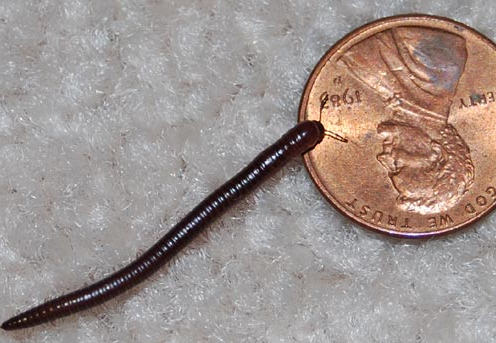
This must be a good year for millipedes. It is, by far, the number one call I’ve been getting. Millipedes  are small, cylindrical arthropods (not insects) that will curl into a coil if disturbed or when they die. If you looked closely at a millipede with a magnifying glass, you would discover that they have two pair of legs for each body segment… giving them the nickname of “thousand legged worm.” They don’t actually have thousands of legs although one rare species can have up 750 legs. Most species have between 34 and 400 legs.

Millipedes live outdoors in damp areas such as under leaves, needles and dead plant debris, or in cracks and crevices. They feed on damp and decaying vegetable matter and are beneficial as “recyclers” of organic matter.

However, they become a pest when they migrate into buildings as accidental invaders. Millipedes are usually found in the garage, basement or lowest level although they may wander into other parts of the house. They are most active at night and usually hide during the day in cracks and other moist locations.

Millipedes are harmless; they do not feed on building structures or furnishings and they can not bite or sting. Millipedes can not reproduce indoors. All millipedes found inside wandered in by mistake. They will usually die in the first week inside because of the low humidity conditions.

Control for millipedes is aimed at keeping millipedes outdoors or reducing their numbers at the source. Cracks, gaps and other points of entry around windows and doors and in foundation walls should be sealed if possible. Removing organic matter such as tall grass or dead leaves from against the house may help, and damp conditions around the house foundation should be corrected.

Insecticides are of limited benefit in controlling millipedes because of the protected areas where they originate and because of the long distances they migrate. In warm weather when millipedes are actively wandering, residual insecticides can be applied in a 5- to 20-foot wide barrier around the building to reduce entry. If practical, also spray areas where the millipedes likely originate. Thorough application will aid in control, but reliance on chemical control alone is often unsatisfactory.

Millipedes migrate long distances during certain times of the year (commonly in spring or fall). Therefore, actions near the house may have no effect. Some sources of millipedes such as woodlands and grassy areas can produce extremely large numbers of millipedes that invade from distances of 50 feet or more.

The indoor use of household insecticides provides little if any benefit. Millipedes that wander indoors usually die in a short time because of the dryness, and spraying cracks, crevices and room edges is not very useful. Sweeping or vacuuming up the invaders and discarding them is the most practical option.

Lace Bugs


Lace bug photos, courtesy of John Wilson.

Lace bug photos, courtesy of John Wilson.

image002

Last weekend at a picnic, we were inundated by a small insect, maybe 1/8″ long, that would bite people. Although they were called many things, some I can’t repeat here, the real name for these pests is lace bugs. There are common pests of a variety of ornamental trees and shrubs in Nebraska, but the most common one is the hackberry lace bug.

Lace bugs use their sucking mouthparts to feed on plant sap. Damage ranges from many small white spots or stipling on the leaves to distortion or complete destruction of plant tissue and leaves falling early. Some lace bugs feed on many different types of plants while others feed only on a narrow range or single species. For example, in addition to hackberry trees, the hackberry lace bug is frequently found on oak, linden and sycamore.

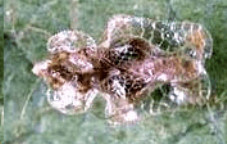
Adult lace bugs are about 1/8″ long x 1/16″ wide. They are somewhat rectangular in outline and have highly ornamented wings and a hood-like structure covering the head. The entire surface is covered with veins that look like lace. The nymphs are oval in outline and some species will be covered with long spines. Most lace bugs move rather slowly when disturbed but the hackberry lace bugs tend to drop from the leaves that are touched.

Lace bugs are usually detected when their damage to the leaves of host plants becomes evident. The nymphs and adults live on the lower surface of leaves and suck juices through slender, piercing mouthparts. This produces yellow or whitish spots on the upper surface of the leaf. As the insects feed, they deposit a hard, varnish-like excrement onto the leaf surface. These are called tar spots or resin spots. Once the damage is noticed, you can check for adults and nymphs by turning over affected leaves and looking on the under side of the leaf.

Most lace bugs spend the winter as eggs that hatch in early spring. There are usually two generations during a growing season. Often the numbers of insects and feeding damage early in the season is so small that feeding symptoms may not be noticed. Populations peak in late summer and results of their feeding can make plants unsightly.

Rarely do lace bugs do damage that permanently injures a plant and therefore rarely warrant control. This is good because trying to adequately treat a large tree would be expensive and is not practical. Also, lace bugs can fly and could reinfest a treated tree in a few days to a week, depending on the insecticide used. The exception is if they attack a young, newly transplanted tree or a tree that is under other stress. Then it may be feasible to treat a smaller tree to reduce the stress.

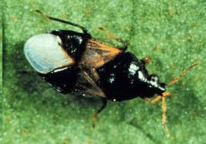
During the late summer, another small insect known as the minute pirate bug cause painful bites that seem out of proportion with their size.The minute pirate bug is similar in size to a lace bug, about 1/8-inch long, oval to triangular in shape, flattened and black with whitish markings on the back. Normally, they are predators and feed on insect eggs and small insects. They feed by impaling their prey with their short blunt beak and sucking the juices.

Minute pirate bugs are found throughout the summer in fields, woodlands, gardens and landscapes. In the late summer, they begin the unpleasant behavior of biting humans. They do not feed on blood or inject a venom or saliva.

People differ in their response to pirate bug bites. Some people have no reaction to the bite, but others have bites that swell like a mosquito bite or turn red. Because the bite is noticeable and the pirate bug doesn’t fly quickly, the victim is usually able to successfully smash the offending insect.

Control of minute pirate bugs is not practical. Repellents are generally not effective, although some people have found applying baby oil or suntan oil liberally to the skin may prevent some bites. For more information on either of these biting insects, contact your local UNL Extension office.


Dry Weather Stress


By John Wilson

John Wilson

John Wilson

Our wet spring turned into a dry summer. At least we haven’t had extreme heat to make matters worse. Lawns, gardens and ornamentals are starting to show signs of our dry weather. Lawns starting to turn brown and wilting plants are the most visible signs. Low yields and poor quality vegetables are additional signs of heat stress.

Brown lawns are becoming a more common sight. Kentucky bluegrass has the ability to go dormant during summer to protect itself from heat and drought. This is what is happening when bluegrass lawns are turning brown… the grass is dormant, not dead.

To conserve water on turfgrass, it is fine to allow bluegrass lawns to go dormant. To keep them alive so they recover when cooler temperatures return, you should apply about a half inch of water every week or two, as needed, if you don’t get it from precipitation.

Fescue lawns are another story. You need to water them enough to keep them green… not golf course green… but at least a light green. Unlike bluegrass, fescue does not go dormant. If it turns brown, it enters a state which we call permanent dormancy… which is another way of saying it died and you will need to reseed the brown areas later this summer.

Ornamental plants and vegetables wilting during the heat of the day are also signs of plants protecting themselves from heat and drought. As long as the soil is moist and the plants only wilt during the day and then recover in the evenings, they are fine.

When plants wilt, you automatically assume they need water. In most cases they do, but check to see the soil is dry before watering. Larger leaved plants, like cucumbers, wilt during the heat of the day even when the soil is moist. This is the plant’s way of reducing the amount of water lost from leaves during the day. They do not need additional water… in fact too much water can injure them more than if you don’t water them at all.

Less obvious signs of heat and drought stress are bitter cucumbers, tomatoes with leathery brown bottoms, missing kernels in sweet corn ears, potato plants turning brown, poor fruit set, and the list could go on and on.

Most cucumber plants contain a bitter compound. When plants are stressed from heat, too little moisture, or poor fertility… bitterness in cucumbers is more prominent. Cucumber varieties listed as bitter-free or burpless are less likely to develop bitterness.

Bitterness is often limited to the stem end of the cucumber and the skin. Cutting off these portions will remove most of the bitterness. If the stress is severe, some cucumbers will be bitter all the way through and are best discarded. Even when pickled, they will remain bitter tasting.

When the bottom of a tomato fruit turns brown, this is blossom-end rot. It is caused by a lack of calcium in the fruit and peppers, squash and watermelon also can be affected. This deficiency is not due to a lack of calcium in the soil. It is result of factors that slow growth, such as heat or drought stress. To reduce blossom end rot, use mulch around plants, maintain uniform soil moisture and avoid overfertilizing with nitrogen.

If hot, dry conditions occur during pollination of sweet corn then pollination is often reduced. The results are sweet corn ears that do not develop kernels to the ear tip or have missing kernels throughout the ear. This sweet corn can still be eaten. Tomatoes with end rot can also be eaten if the brown portion is removed.

Some potatoes are turning brown due to hot air and soil temperatures. Once plants begin to die, harvest the potatoes. Even if there are not many potatoes or the tubers are small, once the plant dies tubers stop developing. If left in the ground, they are likely to rot.

For more information on watering your lawn or garden, contact your local UNL Extension office.

Wimpy Wasps


By John Wilson

Extension Educator

I recently made a stop at a business in town and was surprised to see seven large wasps hovering around the edge of the sidewalk. They looked quite intimidating and I noticed several people give them a lot of room as they walked by. Actually that wasn’t necessary because these large wasps are our perennial mid-summer visitor, the cicada killer.

Each year, people will bring large wasps in a variety of containers to the Extension office while the less daring just describe what they see around their homes. The description usually goes something like this… “It’s a large yellow and black wasp that kept buzzing around the same place in the lawn.” or “It’s a huge hornet that keeps coming back and won’t go away.” or my favorite, “It’s the biggest wasp I’ve ever seen and it scares the bejeebers out of me.”

These are all fairly accurate descriptions of the cicada killer. These large black and yellow wasps, up to two inch long, tunnel in disturbed areas, creating soil mounds and cause concern about stings. In spite of their menacing appearance and seemingly aggressive behavior, these wasps only rarely, if ever, sting. As one insect expert described them, they are a wimp in the wasp world. They are not a threat unless stepped on with bare feet or a person tries to hold one in their hands.

These wasps dig a tunnel in the soil about a half inch in diameter. They get their name, cicada killers, by the next step in their life cycle. After digging a tunnel, they find a cicada and sting it which paralyzes the cicada, but does not kill it. Then they drag this cicada into their tunnel and lay an egg on it. When the egg hatches, the cicada provides food for the larva. It will eventually form a pupa and then the adult wasp hatches out next summer.

These soil-nesting insects hone in on what are, to them, major landmarks… a stick or a small stone… and use these to locate their nest. When someone moves into the area, suddenly the landmarks seem different, so the wasps dart around, reassessing their position. The wasps are not aggressive, but it looks that way. In spite of their intimidating appearance, these wasps can and should be ignored.

Although the cicada killers are not a problem, there are other insects that do deserve our attention. These include crickets, boxelder bugs, Asian lady beetles and other insects that intentionally or accidentally get into our homes. I’m just starting to see crickets now and the others will be looking for shelter later this summer. This is a good time to spray around the foundation to form a barrier to control them before they get into your home and also to seal up any cracks or crevices where they might actually get it. A little prevention now will go a long way to preventing problems later.

For more information about insects that might be invading your home, contact your local UNL Extension office.