Emerald Ash Borers are No Gem


By John Wilson, Extension Educator

Today I wanted to talk about an insect that’s been in the news for over 10 years. The emerald ash borer has the potential to be devastating to ash trees when it gets to our area… but the key word here is WHEN! Emerald ash borer has not been found in Northeast Nebraska. The nearest it has been confirmed is two locations in Omaha and in the northwest corner of Cass County, about half way between Omaha and Lincoln.

            This borer has been in the news long enough tree owners are asking if they should start treating, or take the more radical step of removing  ash trees. I had someone in my office that wanted to cut down a couple healthy ash trees because of this potential threat. Now I have an ash tree just east of my house and I’m sure someday I may need to remove it if emerald ash borers find it.

            But I’m not going to cut it down now and give up potentially 10 to 15 years of shade and beauty for a pest that probably will get here someday, but is not here today. And I’m not going to spend money on treatments to treat a pest that is not here.

            The recommendation of the Nebraska Forest Service and Nebraska Extension is to wait to begin treatment until emerald ash borer has been confirmed within 15 miles of your ash tree(s).  This is the greatest distance adults have been documented to move from an infested tree, but most of the movement has been five miles or less.

            According to the Nebraska Forest Service, treating trees beyond 15 miles will likely provide little or no benefit to the tree but will result in unnecessary environmental exposure to pesticides and unneeded expenses. In addition, drilling holes in the trunk to treat a tree will also injure a tree and eventually repeated treatments will cause decline in an ash tree. So it is unwise to start treatments before it is needed.

            If you have an ash tree, you should know that state and federal agencies are monitoring emerald ash borer infestations and will provide updates on where it is found in Nebraska. Information about it and about when and how to treat ash trees can be monitored on the Nebraska Forest Service website. Go to http://nfs.unl.edu/.

            After I tell people to wait, I’m often asked what if emerald ash borer is in the area, but hasn’t been found yet. It can take up to five years for this borer to kill a tree. So once it is confirmed, it has likely been in the area for at least a few years. However, unlike pine wilt which killed most of our Scotch pine where the tree must be treated prior to the nematode infesting the tree, ash trees that are already infested with emerald ash borer are still treatable and the tree can be saved if the damage is not too severe.

            Instead of making pesticide applications likely to be of little benefit, become more informed to help make decisions about emerald ash borer. If you have an ash tree, decide if you are willing to treat the tree on an annual or every other year basis or if you will replace the tree.

            Valuable trees, such as those providing shade for a home and are in good condition, may be worth the cost of treating. Trees with health or structural issues or those not planted in key locations, may best be replaced rather than treated. For example, if a tree has branch dieback, sparse foliage, or severe trunk injuries, it probably is not worth the expense of treating.

            Currently five Nebraska counties, Dodge, Washington, Douglas, Sarpy and Cass are in a quarantined area. Ash materials from these counties including trees, logs, branches, roots, green lumber, hardwood firewood and chips; as well as viable emerald ash borers must not be transported out of these quarantined areas.

            There are also a lot of other insects that look similar to and can easily be confused with the emerald ash borer. If you have an insect that you think might be emerald ash borer, take it to your local Nebraska Extension office for identification. Images of look-alike insects can also be found on the Nebraska Forest Service website at http://nfs.unl.edu/.

            For more information on emerald ash borer or on selecting a replacement shade tree, contact your local Nebraska Extension office.
Commision Stresses Park Visitors Restrict Firewood Movement Following EAB Confirmation


LINCOLN – Now that the presence of the invasive emerald ash borer (EAB) has been confirmed in Nebraska, the Nebraska Game and Parks Commission emphasizes that campers should continue to restrict the movement of firewood to prevent the spread of EAB throughout the state.

The Nebraska Department of Agriculture on June 8 confirmed the presence of the EAB in Omaha’s Pulaski Park. EAB is a tree-killing beetle native to Asia. It can move from state to state in firewood.

As in recent years, a Voluntary Firewood Exchange Program is in place at several state park areas to prevent the movement of the emerald ash borer within the state. Campers at Niobrara, Ponca, Eugene T. Mahoney and Indian Cave state parks, and Red Willow Reservoir, Medicine Creek Reservoir, Branched Oak, Lewis and Clark, Pawnee and Two Rivers state recreation areas who bring firewood from outside of the state should exchange their wood at the park office or campground host for an equal volume of locally acquired firewood.

In addition, it is recommended that Nebraska residents also acquire firewood at or near any park destination — whether that be a state park, city park, national park or private campground — rather than bringing it from other locations. Locally acquired firewood will be sold at park offices or concessions inside Chadron, Fort Robinson, Indian Cave, Eugene T. Mahoney, Niobrara, Platte River, Ponca and Smith Falls state parks and Branched Oak, Fremont, Lake Maloney, Lake Minatare, Lewis and Clark, Louisville, and Two Rivers state recreation areas.

Wood lying on the ground at Nebraska Game and Parks properties may be collected and burned as firewood on site.

Park visitors are commended for their cooperation with the wood exchange program and for their diligence in preventing the spread of EAB. Visitors are also reminded to enjoy campfires safely and in compliance with regulations to prevent wildfires.

More information can be found at: emeraldashborer.info and dontmovefirewood.org.

Emerald Ash Borer and Camels


By John Wilson, Extension Educator

In my 38-year Extension career, I never remember talking so long about a pest that wasn’t even here! I’m sure part of the reason is that emerald ash borers (EAB) are so devastating to ash trees. Since its arrival, EAB has killed hundreds of millions of ash trees.

EAB was first discovered in the United States in 2002 near Detroit in southeastern Michigan. I attended a conference in Michigan in the summer of 2007 and saw the devastation first hand. By then, EAB had spread through most of Michigan’s lower peninsula as well as into the upper peninsula, Ontario (Canada), neighboring states, and to an isolated outbreak in Maryland. The Maryland area was over 300 miles away from the closest confirmed case of EAB at that time.

The Maryland outbreak is significant because it shows how EAB can move over long distances. On its own, the adult EAB is not a strong flyer, according to the USDA Forest Service, and most will move less than two miles a year. (About 1% of the mated females may disperse up to 12 miles.) With help from humans, however, it is a great traveler. It has been known to travel large distances, migrating in firewood or nursery stock from infected areas.

Currently, the closest confirmed infestation to Nebraska is in Union County, Iowa, about 80 miles east of Plattsmouth on Highway 34. Other infestations have been confirmed in the Kansas City area as well as in Boulder, Colorado.

Our current recommendation is to not start treating for EAB until its presence has been confirmed within a 15-mile radius of your ash trees. Thus, at this time, we would not recommend treating any ash tree in Nebraska for EAB.

I’m sure many of you thought I’d completely lost my mind (and you might have a point) when you saw a reference to camels in this column’s title. Let me explain.

Last summer I was visiting with an older gentleman who lived near Pierce. When he found out what I did for a living he was quick to ask what I knew about emerald ash borer. I explained that it will almost certainly get here – someday, but I would not recommend treating for this pest until it has been confirmed within 15 miles of his home.

He told me he recently went to a large chain nursery and asked them about EAB. They told him he needed to start treating his ash trees immediately and sold him a treatment costing several hundred dollars.

I asked him if he knew that same product would be 100% effective on preventing camel damage to his ash trees. He glared at me and snapped back that he wasn’t worried about camel damage, he didn’t have any camels. Before I could respond, his glare turned to a big grin and all he said was, “I get it!” He also mentioned that he would be returning any unused product. When I counted my many blessings that night, I included that I would NOT be the person at the nursery accepting the product he returned.

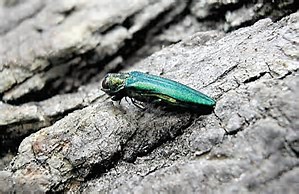
EAB adults are small, metallic green beetles. They are about 1/2 inch long and 1/16 inch wide. Several other green insects are easy to mistake for EAB, but you can distinguish EAB based on body shape. If you look at EABs from above, their body is shaped like the head of an ax, blunt and flat across the head and tapered toward the tail. One other unique characteristic is that when their wings are spread like they are flying, the top of their body which is normally hidden by their wings is reddish in color.

Adult EABs emerge in late May to late June, leaving a “D-shaped” hole in the trunk. Females lay eggs about two weeks after they emerge and these eggs hatch in one to two weeks. The tiny larvae bore through the bark and into the cambium, the area between the bark and the wood, where nutrient levels are high.

EAB larvae injure ash trees by feeding under the bark where they damage the conductive tissue or “plumbing” of the tree, disrupting the flow of moisture and nutrients. The larvae eventually form a pupa and the new generation of adults emerge the following May or June to begin the cycle again.

Understandably, homeowners are concerned about losing their ash trees to the EAB. However, it is important to not begin insecticide treatment too early as premature treatments can have negative consequences. Some treatment involve drilling holes around the trunk through the bark and into the cambium to inject a systemic insecticide. Research has shown that healthy trees can be injected seven to 10 times before trunks become so damaged that trees begin to decline.

The drilled holes also open the trunk to insect pests and decay fungi. Drilling may break through the internal barriers in the trunk the tree is using to wall off internal decay, causing decay to spread. Also, the insecticide itself can cause internal damage. This is why treating ash trees for EAB is not, and will not, be recommended for trees until it has been found within 15 miles of a tree’s location… or if you are concerned your ash trees might be overrun by camels.

For more information including images to help identify this pest and the damage it causes, visit the Emerald Ash Borer Information Network at http://www.emeraldashborer.info/ or contact your local Nebraska Extension office.

Ash Trees and the Emerald Ash Borer


By John Wilson, Extension Educator

The emerald ash borer has the potential to be devastating to ash trees when it gets to Nebraska. But the key word here is WHEN! Emerald ash borer has not yet been found in Nebraska. The nearest it has been confirmed is in Iowa, about 80 miles east of Plattsmouth, Nebraska.


This borer has been in the news long enough tree owners are asking if they should start treating, or take the more radical step of removing  ash trees. I just had someone in my office this week that wanted to cut down a couple healthy ash trees because of this potential threat. Now I have an ash tree just east of my house and I’m sure someday I may need to remove it if ash borer gets here.


But I’m not going to cut it down now and give up potentially 10 to 15 years of shade and beauty for a pest that might get here someday. And I’m not going to spend money on treatments to treat a pest that is not here.


The recommendation of the Nebraska Forest Service and UNL Extension is to wait to begin treatment until emerald ash borer is confirmed to be within 15 miles of a tree.  According to the Nebraska Forest Service, treating trees beyond 15 miles will likely provide little or no benefit to the tree but will result in unnecessary environmental exposure to pesticides as well as unneeded expenses.


If you have an ash tree, you should know that state and federal agencies are monitoring emerald ash borer infestations and will provide updates when it is found in Nebraska. Information about it and about when and how to treat ash trees can be monitored on the Nebraska Forest Service website. Go to http://nfs.unl.edu.


After I tell people to wait, I’m often asked what if emerald ash borer is in Nebraska but hasn’t yet been found. It can take up to five years for this borer to kill a tree. So once it is confirmed, it has likely been in the state for at least a few years. However, unlike pine wilt killing Scotch pine where the tree must be treated prior to the nematode infesting the tree, ash trees that are already infested with emerald ash borer are still treatable and can be saved if the damage is not too severe.


Instead of making pesticide applications likely to be of little benefit, become more informed to help make decisions about EAB. If you have an ash tree, decide if you are willing to treat the tree on an annual basis or if you will replace the tree.


Valuable trees, such as those providing shade for a home and are in good condition, may be worth the cost of an annual treatment. Trees with health or structural issues or those not planted in key locations, may best be replaced rather than treated annually. For example, if a tree has branch dieback, sparse foliage, or severe trunk injuries, it is probably not worth the expense of treating.


If you are planting a new tree this spring, avoid ash trees. Most types of ash are susceptible to emerald ash borer. If you know you will not treat an ash tree once it is infested, do you have space on your property to plant another tree now to take over the landscape function if the ash tree dies?


When Dutch elm disease killed American Elms, many of these trees were replaced with green ash. This created another monoculture susceptible to pests. We could now lose a large percentage of these trees. Let’s not make the same mistake twice. Select trees for diversity.


A few readily available large trees to plant are honeylocust, American linden, Norway maple, Miyabe maple, hybrid elms and white oak. Other species not frequently planted in a landscape include Kentucky coffeetree, shagbark and bitternut hickory, silver linden and horse chestnut.


For more information on emerald ash borer or on selecting a replacement shade tree, contact your local UNL Extension office.

Emerald Ash Borer


By John Wilson, Extension Educator

The emerald ash borer (EAB) is an insect that’s been in the news for over 10 years. It has the potential to be devastating to ash trees when it gets to Nebraska… but the key word here is WHEN! Emerald ash borer has not yet been found in Nebraska. The nearest it has been confirmed is in Iowa, about 80 miles east of Plattsmouth, Nebraska.

This borer has been in the news long enough tree owners are asking if they should start treating, or take the more radical step of removing  ash trees. I just had someone in my office last week that wanted to cut down a couple healthy ash trees because of this potential threat.

Hopefully I talked them out of that. I explained that I have an ash tree just east of my house and I’m sure someday I may need to remove it if ash borer gets here. But I’m not going to cut it down now and give up potentially 10 to 15 years of shade and beauty for a pest that might get here someday. And I’m not going to spend money on treatments to treat a pest that is not here.

The recommendation of the Nebraska Forest Service and Nebraska Extension is to wait to begin treatment until emerald ash borer is confirmed to be within 15 miles of a tree. EAB is not a strong flyer and doesn’t move great distances on its own. According to the Nebraska Forest Service, treating trees beyond 15 miles will likely provide little or no benefit to the tree but will result in unnecessary environmental exposure to pesticides as well as unneeded expenses.

If you have an ash tree, you should know that state and federal agencies are monitoring emerald ash borer infestations and will provide updates when it is found in Nebraska. Information about it and about when and how to treat ash trees can be monitored on the Nebraska Forest Service website. Go to nfs.unl.edu.

After I tell people to wait, I’m often asked what if emerald ash borer is in Nebraska but hasn’t yet been found. It can take up to five years for this borer to kill a tree. So once it is confirmed, it has likely been in the state for at least a couple years. However, unlike pine wilt killing Scotch pine where the tree must be treated prior to the nematode infesting the tree, ash trees that are already infested with emerald ash borer are still treatable and can be saved if the damage is not too severe.

Instead of making pesticide applications likely to be of little benefit, become more informed to help make decisions about EAB. If you have an ash tree, decide if you are willing to treat the tree on an annual basis or if you will replace the tree.

Valuable trees, such as those providing shade for a home and are in good condition, may be worth the cost of an annual treatment. Trees with health or structural issues or those not planted in key locations, may best be replaced rather than treated annually. For example, if a tree has branch dieback, sparse foliage, or severe trunk injuries, it is probably not worth the expense of treating.

If you are planting a new tree this spring, avoid ash trees. Most types of ash are susceptible to emerald ash borer. If you know you will not treat an ash tree once it is infested, do you have space on your property to plant another tree now to take over the landscape function if the ash tree dies?

When Dutch elm disease killed American Elms, many of these trees were replaced with green ash. This created another monoculture susceptible to pests. We could now lose a large percentage of these trees. Let’s not make the same mistake twice. Select trees not common in the landscape for more diversity.

A few readily available large trees to plant are honeylocust, American linden, Norway maple, Miyabe maple, hybrid elms and white oak. Other species not frequently planted in a landscape include Kentucky coffeetree, shagbark and bitternut hickory, silver linden and horse chestnut.

For more information on emerald ash borer or on selecting a replacement shade tree, contact your local Nebraska Extension office.

John Wilson

John Wilson