Happenings at Oakland Heights


Oakland Heights News by Nancy Silvey

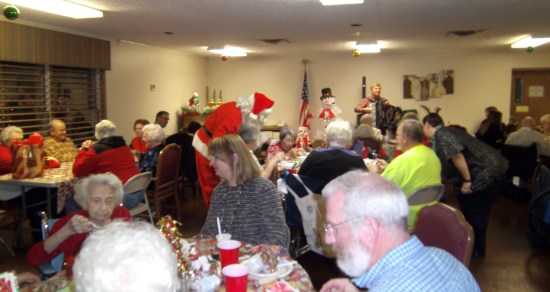
We had nice evening for the resident Christmas party last Friday night; it was nice to see all of the family members here for the party.  We would like to thank Wayne Miller for the entertainment and Dan Rosenbaum for playing Santa and a big thanks to all of the staff who helped out, it made for a nice party for the residents. A couple of things going on this week on Thursday December 17th we will be have a Christmas shop open for the resident to come in and do a little Christmas shopping for themselves we will have a large variety to choose from. On Saturday December 19th at 2:30 pm the rusty buckets will be here to perform. Next week is Christmas week and on Thursday December 24th we will be have a Christmas Eve Service at 2:30pm given by Curt Hineline. We have a birthday to celebrate this week Lamae Johnson on December 20th.

Church Service for Sunday December 20th at 2:30 pm will be given by the Craig/Alder Grove Church with a luncheon served afterwards. On Monday December 21st at 2:30 pm is Communion with First Lutheran Church and on Tuesday December 22nd at 9:30 am is Catholic Mass with Father Paul.

Activities for the week of December 21st to December 26th are as followed, Reading with Marilyn, Manicures, Sing a Long, Game Day, Bingo the w/Methodist, reading group, Bible Fellowship, Saturday morning Christmas video, and Lawrence Walk.

Volunteers signing in last week were; Marilyn Baker, Judy Nelson, Betty Hanna, Patty Miller, Dani Moseman, Di Ruwe, Bonnie Fleischman, Ann Anderson, Nadine Anderson, Cathi McMurtry, Mary Fritts, Lola Bridgeford, Sly Rouse, and Seth Anderson.

Guest signing in this past week was; Cathi McMurtry to see Teresa Bowman, also Dawn Anderson and Holly Perez to see Iva Anderson.

Christmas party at Oakland Heights. Photo courtesy of Oakland Heights.

Christmas party at Oakland Heights. Photo courtesy of Oakland Heights.


Village of Decatur Meeting Minutes


Village Board of Decatur Regular Meeting
December 10, 2015 4:36P.M.

The Board of the Village of Decatur met in regular session at 4:36 P.M. at the City Hall on December 10th, 2015. Visitors signing in Debbie Krutilek, Dale Wolf, Alta Wolf, Nina Mussack, Jim Maryott, Debbie Maryott, Mark Siecke, Jack Huffman, Jill Maryott, Kay Kellogg, Karma Farrens, Skip Farrens, Tim Slaughter, Jason Troutman, Steve Kellogg, Bob Kellogg, Ellen Olson, Not signing in Chelsey Dunning, and Matt Munderloh.


1)        The meeting was called to order by Chairman Loretta Kellogg

Kellogg stated we do not have a quorum present to run this meeting, so the meeting is adjourned.

Adjourned at 4:37
 

Loretta Kellogg/Chairperson

Ann Chytka /Village Clerk


News From Bancroft Senior Center


The senior center provides Information and Assistance to any individual who is looking for services for themselves or another person 60 years and older, the center manager and/or center participant can provide information to individuals on services available within the community. We link individuals to the services and opportunities that are available within or beyond the community itself. We will then establish adequate follow-up procedures to see that their needs were met. For more information call 402-648-3387.

*If you are 60 years and older and need information on programs designed to help keep you in your home longer or if you need legal help, contact Connie at 402-648-3387 or in the evening at 402-648-7648.

* We have the following medical equipment to loan out on an as need basis, wheel chair, bath seats, toilet seat riser and portable toilet chair, crutches or walkers. Call 402-648-3387 during office hours.

Meals on Wheels

*Would you like to get Meals on Wheels? Anyone over the age of 60 years and lives within the city limits are eligible for these meals. You may sign up anytime for the Meals on Wheels program; you can get the meals delivered however many times you want them each week. You must call 402-687-2332 before 8:30 a.m. if you want a meal that day. The suggested donation for the meals is $4.00.

Weekly Activities:

Wed. Dec. 16: Melody chime practice at 9:00 a.m. come for coffee at 10:00 am. Come and participate in the Christmas party at 2:00 p.m. The melody chimers will entertain you at 2:00 p.m. and then we will play some games before we have lunch at 3:30 p.m. bring some snack items for lunch.

Thurs. Dec. 17: Tai Chi class is at 9:30 and walking club at 10:45 a.m. Rolls and coffee           from 9 – 11 a.m. Sign up if you would like to play in the pitch tournament at 1:30 p.m.

Fri. Dec. 18: The legal aid attorney will be at the center at 1:00 p.m. for any of you who wish to visit with her privately and at 1:30 she will give a short talk and answer any questions you may have. The card playing will begin around 1:45 and lunch will be served about 3:50 p.m.

Mon Dec. 21: The monthly board meeting will be at 10:30 a.m. sign up to play in the pitch tournament at 1:30 p.m.

Tues. Dec. 22: Tai Chi class is at 9:30 a.m. and walking club at 10:45 a.m. Come and have coffee with us in the morning. We will play bingo at 2:00 p.m.

Wed. Dec. 23: There will be melody chime practice at 9:00 a.m. Invite you to sign up for the pinochle tournament at 1:30.

Protecting Our Local Communities


By U.S. Senator Deb Fischer

In the wake of the financial crisis, the 111th Congress created the Consumer Financial Protection Bureau (CFPB), which is charged with protecting consumers from financial sector abuse. The agency is also responsible for ensuring our financial institutions follow the laws of the land.


Four and a half years later, the CFPB exerts immense influence over all sectors of the economy. The agency’s budget has grown by 74 percent in the past two years, from $357 million in 2013 to $622 million in 2015. Over the years, the CFPB has become a bureaucracy that has too much power over the free market. As such, it requires robust oversight from Congress.


Originally, Congress established the CFPB to regulate the markets for consumer financial products and services, but they have since expanded their reach beyond that. It is now placing a considerable strain on our pocket books, and it is inhibiting economic growth.


In Nebraska, community banks are feeling the effects of the agency’s misguided rules. Under current law, the CFPB provides exemptions to certain lending restrictions for areas deemed rural. Through these exemptions, community banks are able to increase access to credit for rural areas and their dependent industries, such as agriculture. But first, a county must receive the rural designation. Due to flaws in the current CFPB review process, many rural areas are not being labeled correctly and, as a result, they are missing opportunities for economic growth.


For counties with densely-populated areas and rural reaches, the agency’s designation system is failing. Adams, Buffalo, and Hall counties have all been deemed “non-rural.” Take Hall County as an example. The fact that Grand Island has a population close to 50,000 shouldn’t prevent a producer from Doniphan from accessing the credit they need to grow their local economy.


What’s more, once the CFPB makes a county-by-county designation, it is set in stone. There are no mechanisms in place to allow an area to appeal their designation. This means many rural communities are being left without a voice in the process.


In the U.S. Senate, one of my priorities is creating a regulatory environment to help our community businesses expand and thrive. That is why I cosponsored the Helping Expand Lending Practices (HELP) in Rural Communities Act. This legislation, which was signed into law as part of the highway bill on December 4, 2015, will allow counties that have been improperly designated as “non-rural” to provide more information and encourage the agency to reevaluate their status. It will also designate specific criteria for the agency to consider when making a county designation. This common-sense legislation would provide our local banks with some relief from onerous federal regulations and help build stronger Nebraska communities.


I believe this structural reform is an important step forward in reforming the CFPB processes. Our rural communities need the freedom and flexibility to prosper and grow. As your Senator, I will continue conducting aggressive oversight at the federal level to address government overreach and protect Nebraska families.


Thank you for participating in the democratic process. I look forward to visiting with you again next week.


Game and Parks Surveying Deer Hunters


The Nebraska Game and Parks Commission is conducting a survey of Nebraska deer hunters Dec. 14 – Jan. 22, 2016. This survey is conducted every five years and is designed to gather hunter information about experiences, attitudes and opinions related to the 2015 deer season.

The public’s input is important to Game and Parks and is another way in which hunters can participate in Nebraska’s deer management program. Hunters are the primary tool used to manage the state’s deer herd. It is important that the public’s opinions are considered in setting future deer season regulations.

To access the survey, visit: http://bit.ly/NGPC-DeerHunterSurvey.

Moose Sighted in North Platte


Nebraska Game and Parks Commission officials confirmed a weekend sighting of a moose within the city limits of North Platte.

The moose had been in the area for about a month before being spotted in town on Dec. 13, according to officials. Game and Parks biologists are communicating with local law enforcement about the moose’s whereabouts. If the opportunity presents itself, officials will attempt to direct the moose out of town.

Officials stress that people should not approach the moose to take pictures or attempt to feed it as they have been known to become aggressive toward people and pets.

Aggressive moose often show a variety of signs, including pinned back or flattened ears with hair raised around the neck and back. Other signs are a lowered head, stomping feet and teeth clicking or licking of its lips. In the case of a moose charging, people are encouraged to run and not stand their ground.

The State of Nebraska Agriculture


By Governor Pete Ricketts

Over the past few weeks, I have joined Nebraska Cattlemen and Farm Bureau members at their annual conferences.  These events are always great opportunities to reflect on the year’s successes and challenges while also sharing ideas on how we can work together to continue to grow agriculture which accounts for one in four jobs in Nebraska.  While our state’s farmers and ranchers have faced challenges ranging from lower commodity prices to avian influenza this year, Nebraska agriculture continues to find new ways to grow.  Let’s review some of the events of the past year that positively impacted our state’s number one industry.


In January, I recommended dramatically increasing property tax relief provided through the Property Tax Credit Relief Fund.  Working with the Legislature, we were able to successfully deliver $408 million in property tax relief over the next two years – an over 45 percent increase over previous budgets.  While this is significant progress, there is more work to be done to improve Nebraska’s tax climate.


In March, I hosted the 27th Annual Governor’s Ag Conference in Kearney.  At the conference, we discussed the future of international trade, expansions of value-added agriculture, farm transitions to the next generation, and federal regulatory and policy issues impacting Nebraska farms and ranches.


In April, the Department of Agriculture and I led a delegation of Nebraska beef producers to New York City to visit four venues to promote Nebraska beef.  At these venues, we met with food journalists, nutritionists, and culinary experts to highlight Nebraska’s quality beef products and educate them on what makes Nebraska’s beef the best in the world.  Promotion and education are critical components of ensuring that today’s consumers understand how our Nebraska family farms operate.


This year, my administration also led international trade missions to the European Union and Asia.  In Europe, we visited the 2015 World Food Expo in Milan and Bologna to meet with key executive and organization representatives to tout Nebraska as an ideal location for food processing.  This fall, Lt. Governor Foley and Ag Director Greg Ibach led a delegation of ag producers on a trade mission to Japan, our state’s third largest trading partner.  Shortly following, a delegation traveled with me to Tokyo to meet with Marubeni, Itochu, and Kewpie, Japanese commodity and food processing companies that invest in Nebraska.  Additionally, Director Ibach traveled to Africa to explore other trade opportunities.


In June, Congress passed legislation authorizing Trade Promotion Authority (TPA), a policy which my administration supported because it opens up a path for additional opportunities for Nebraska to increase our exports and grow our economy.  TPA has helped move forward the successful conclusion of the negotiation of the Trans-Pacific Partnership (TPP).  TPP will lower trade tariffs imposed by countries such as Japan and Malaysia.


Throughout the year, we added eight counties to our Livestock Friendly County program.  In September, Hayes County became the 35th county in our state designated as “livestock friendly.”


In October, the U.S. Court of Appeals for the Sixth Circuit blocked President Obama’s Waters of the U.S. rule, also known as WOTUS.  This rule would have given the Environmental Protection Agency expansive new authority over Nebraska’s waterways that are the lifeblood of agriculture in our state.  Thanks to the leadership of Nebraska Attorney General Doug Peterson, our state did not have to comply with WOTUS this year, and we will continue to fight its implementation.


These are just a few of the highlights from the past several months.  As we enter 2016, my administration remains committed to helping our ag producers take advantage of new opportunities and confront whatever challenges lie ahead for agriculture in our state.  Working together, we can ensure that the industry continues to grow.  If you have ideas on how we can continue to grow agriculture in our state, I hope you will take a moment to share them with me by emailing pete.ricketts@nebraska.gov or calling 402-471-2244.

Governor Pete Ricketts

Governor Pete Ricketts


West Entrance to Lake Wanahoo SRA Reopened


The west entrance to Lake Wanahoo State Recreation Area has reopened following completion of a paving project. The campground and boat ramp have also reopened to public use.

The entrance closed on Nov. 18 while the entrance road was paved. The campground and boat ramp – both of which were accessible via the west entrance – also closed during this time.

While the entrance, campground and boat ramp have all reopened, some construction work is still being completed around the park.

The paving project was a joint effort between the Nebraska Game and Parks Commission and the Lower Platte North Natural Resources District.

A Highway Bill for Nebraska


By U.S. Senator Deb Fischer

Nebraskans are blessed with good and reliable roads, which serve as the lifeblood of our urban communities and rural reaches.


Our state and local officials work hard to improve existing roads and plan for the future. But these projects are costly and don’t happen overnight. It takes an immense amount of planning and resources to execute major projects. Most of all, they require regulatory certainty and funding from the federal government to do so.


As Nebraskans, we value reliability and efficiency. However, states across our nation have struggled to plan for transportation projects because Washington had failed to provide much-needed regulatory certainty. Instead of prioritizing long-term solutions to address our nation’s transportation challenges, Congress passed 36 short-term extensions over the past decade. This prevented states and local communities from planning for new projects. But, I have positive news to share: At long last, Congress has put forth a solution to this problem.


On December 3, 2015, Congress passed a five-year highway bill. This agreement is an extraordinary accomplishment, and it includes big wins for Nebraska. Over the next five years, it will provide Nebraska with 1.5 billion dollars to update and maintain our roads, highways, and bridges for years to come.


As chairman of the Senate Commerce Subcommittee on Surface Transportation, and an active member of the Senate Environment and Public Works Committee, I was deeply involved with this legislation since my first year in the U.S. Senate. I also served on the conference committee that was charged with resolving the differences between the House and Senate versions of the bill. It was a lengthy process, and it did not come easy. It took hard work and significant compromise with my colleagues across the aisle in both legislative chambers. Through it all, I fought for Nebraska.


Because of this critical legislation, you will see transportation projects across the state up and running and at a faster pace. The influx of resources for Nebraska means existing roads can be made safer. Moreover, new projects are on the horizon to accommodate growing communities.


Through a new freight program established in the bill, critical transportation dollars will be funneled to rural Nebraska projects like the Heartland Expressway. Our urban areas will benefit too. In Lincoln and Omaha, buses and other transit facilities will receive more dollars for important updates.


The bill also helps our ag producers. It reverses $3 billion in cuts to the crop insurance program included in the two-year budget agreement in October. The bill also reduces the regulatory burdens on our producers by allowing them to transport up to 1,000 gallons of diesel fuel freely.


Furthermore, the highway bill helps our veterans. It includes a pilot program that will expand opportunities for young veterans with commercial driver’s licenses by allowing them to drive across state lines. Our veterans have developed important skills while serving our nation. This provision will help them find employment and use those skills once they return to civilian life. In 49 states, commercial drivers under the age of 21 can already drive vehicles within a state. With this common-sense program in the highway bill, appropriately licensed veterans will now be able to deliver goods from Omaha to Council Bluffs.


Working for Nebraska on this legislation has truly been one of the highlights of my time in the U.S. Senate. By strengthening our national transportation network, we can grow our economy and improve safety in our communities. So, as you hit the road this holiday season, rest assured that our roads, bridges, and highways will now be safer for years to come.


Thank you for participating in the democratic process. I look forward to visiting with you again next week.

U.S. Senator Deb Fischer
U.S. Senator Deb Fischer


Fueling Our Kids and the Future: School Lunch


By Sandra Renner, sandrar@cfra.org, Center for Rural Affairs, Farm to School Project Specialist 

In the past three decades, much has changed in our food system and society. Schools aren’t purchasing as many fresh foods, yet they have more nutrition requirements to fill. Schools got away from purchasing locally. The number of local farms to purchase edible food from has become scarce.
Recently, my kids invited me to eat lunch at school. Their school lunch menus show what items are locally sourced. Granted, I get to be a farm to school geek for a living, but to me that also meant an average parent would know that locally grown, fresh food was prepared in their school’s kitchen.
Each month seasonal foods are taste-tested in the classroom. Recipes and shopping tips also come home. Considering cuts to food science and ag classes in many schools, or not learning these basic skills at home… some parents simply do not know how to prepare fresh produce. Farm to School gives us a chance to change this.
When I ate school lunch, I saw a tray of nutritionally dense food. It made me feel good that the school is feeding the kids to perform well.
As a kid growing up in rural America, I could not imagine a world that agriculture and food prep skills weren’t a part of. But, today I see how quickly we are losing these skills. Farm to School is a tool for us to use to provide self-sufficiency and a better health legacy to our future keepers of the food system.